VI. Workflow Decisions in PamGene Data Analysis
Should the QC Thresholds Be Adjusted?
PTK fractionPresent and STK qc_stk_thr.ratio:
- Default threshold = 0.25, allowing for peptides to be missing in max 1 condition if there are 4 conditions.
- Inspect data and adjust threshold if appropriate:
- More than 4 conditions?
- Only few peptides passing QC?
- Experiment design indicates adjustment (e.g. if inhibitors are very potent, peptides might be present only in the control condition).
Log or VSN?
As default, log2 transformation is used, since VSN transforms the data in a way that fold change directions are harder to interpret.
Read more about how to decide on base normalization here.
Limma decisions
Is there biological pairing and are the paired samples in 1 chip?
│
├── Yes → Paired Limma
│
└── No → Is there batch effect?
         │
         ├── Yes → ComBat → Unpaired Limma
         │                  (set stricter significance threshold)
         └── No  → Unpaired Limma
Biological and technical pairing
| Type of pairing | Description | Paired / unpaired analysis? |
|---|---|---|
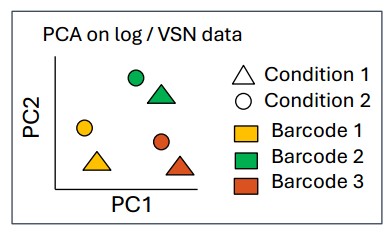
| Biological pairing | Control and Test are from the same replicate (e.g. same cell line). Pairing factor is typically barcode (= Replicate). |
Paired analysis is better than unpaired— it is more powerful and sensitive because it accounts for technical variability. |
| Technical pairing | Comparing cell line 1 to cell line 2 on the same chip. | Unpaired analysis. |
 |
Do Limma before or after batch correction?
Phosphosite analysis should generally be done on log / VSN data, not on ComBat-corrected data.
- ComBat corrects by estimating the mean, which removes a degree of freedom from the dataset.
- In limma, this lost degree of freedom cannot be accounted for.
- This leads to inflated significance (more false positives).
Exception: When there are many replicates (e.g. 2 runs × 6 replicates), and / or no pairing can be done, and the batch effect is large, ComBat is acceptable. But stricter significance thresholds must be set (e.g. P < 0.001, or set FDR threshold).
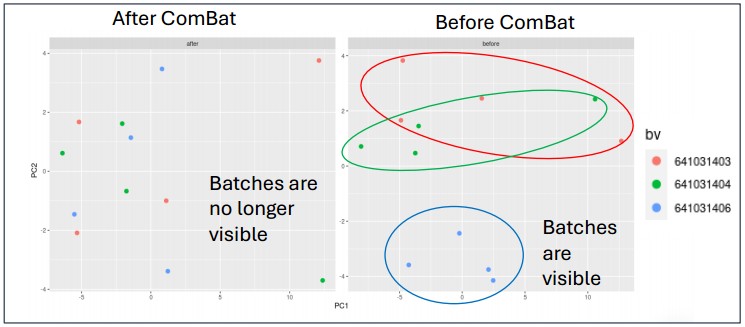
Checking for batch effect: - Use PCA, color on batches, and observe clustering of technical batches. - 1-run experiments: batch effect may be on Barcode. - Multi-run experiments: check batch effect on Run first (usually larger than Barcode effect). Correcting for too many batch types can introduce bias — if a Run effect exists, correcting for Barcode as well is usually not necessary.
UKA before or after batch correction?
In UKA, there is no pairing option available.
ComBat should be done for UKA (or for any multivariate analyses such as PCA, class prediction) only if: 1. The design is balanced (conditions are balanced across technical batches). 2. There is a batch effect and ComBat can remove it.
If ComBat cannot remove the batch effect, UKA should be done on log/VSN data.
Is there batch effect?
│
├── Yes → ComBat → UKA on log/VSN + ComBat-corrected data
│
└── No  → UKA on log/VSN data
Before/after ComBat PCA example: